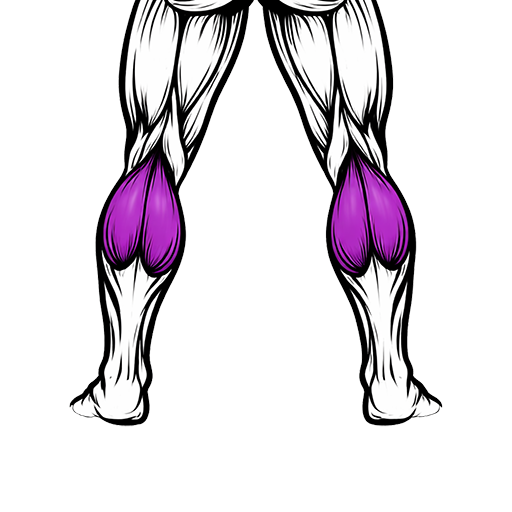
VILPA: Calf-raise micro-set
In Calicen, a calf-raise micro-set is a quick activity snack used every few hours to replace passive sitting with repeated ankle work. Its metabolic and AMPK stimulus is smaller and less established than a vigorous full-body burst, but it is exceptionally easy to repeat and trains the lower-leg capacity needed for walking, stairs, balance corrections, and push-off.
Legs
Isolated
At a glance
Difficulty
Easy
Exercise Type
Vilpa
Muscle Group
Calves
Equipment
Bodyweight
Force Type
Pull
Mechanics
Isolation
Why this exercise matters
Calf raises are a high-adherence way to spread lower-leg work through the day. Their strongest outcome is preserving walking and ankle capacity, with sedentary interruption as an added metabolic advantage.
- Movement frequency — Frequent standing sets break uninterrupted sitting; research on activity breaks supports better post-meal glucose handling, although the exact effect of calf raises alone is not established.
- Walking propulsion — The soleus and gastrocnemius produce push-off for gait, stairs, hills, and faster walking.
- Balance reserve — Calf strength helps control forward sway and makes small standing balance corrections more effective.
- Ankle resilience — Controlled full-range repetitions progressively expose the calf–Achilles complex to useful load.
How to perform
Treat the practice as a brief, deliberate movement break and keep the prescribed quality more important than the clock.
- Setup — Use Step or floor; optional support and clear enough space to hold or repeat the position safely.
- Prescription — Complete 2–3 × 15–30 reps.
- Key cue — Use full controlled range and a brief top pause.
- Reset — Relax fully or return to an easy position between efforts rather than carrying unnecessary tension.
- Scale — Two-leg floor raises are easiest; avoid bouncing.
What to avoid
Do not let the short format justify poor positioning or excessive effort. The activity should remain repeatable and symptom-free.
- Exercise-specific safety — Two-leg floor raises are easiest; avoid bouncing.
- Breathing/tension — Use full controlled range and a brief top pause; avoid unnecessary breath-holding unless the technique explicitly requires a gentle respiratory phase.
- Stop criteria — Stop for sharp pain, numbness, dizziness, or loss of control.
- Terminology — This website category is broader than the scientific definition of VILPA.
- Bouncing repetitions — Fast partial bounces hide weakness and shift stress to the tendon; use controlled full-range repetitions and progress load rather than speed.
Target Muscle