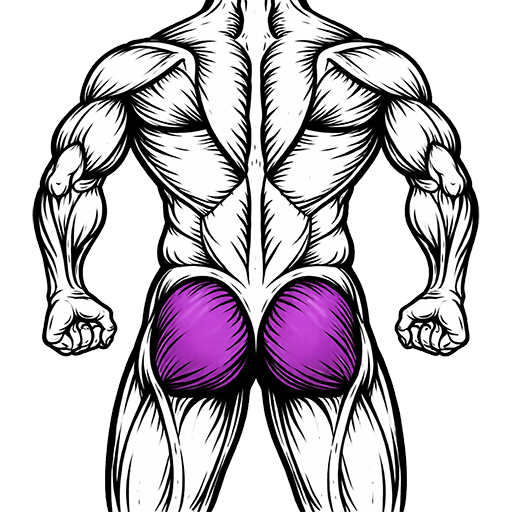
VILPA: Glute bridge hold
In Calicen, the glute bridge hold is a short lower-body activity snack repeated across the day to interrupt sitting and reactivate hip-extension muscles. It is low impact but can create substantial local tension in the glutes, muscles that help preserve standing, gait, stair climbing, and independent transfers.
Legs
Compound
At a glance
Difficulty
Easy
Exercise Type
Vilpa
Muscle Group
Glutes
Equipment
Bodyweight
Force Type
Push
Mechanics
Compound
Why this exercise matters
The bridge is a practical way to keep the hip extensors contributing during a day otherwise dominated by sitting. Its strongest benefits are muscular and functional rather than cardiovascular.
- Metabolic interruption — Sustained tension in the large glute muscles creates an acute local energy demand; AMPK activation depends on intensity and should not be described as guaranteed all-day elevation.
- Hip-extension reserve — Glute capacity supports standing up, climbing steps, walking propulsion, and stabilizing the pelvis.
- Low-impact strength — The floor-supported position adds meaningful hip work without jumping or repeated foot strikes.
- Progression pathway — Better glute control and endurance prepare the body for hip thrusts, hinges, squats, and loaded carries.
How to perform
Treat the practice as a brief, deliberate movement break and keep the prescribed quality more important than the clock.
- Setup — Use Floor; mat and clear enough space to hold or repeat the position safely.
- Prescription — Complete 3 × 30–60 sec.
- Key cue — Finish with glutes, not excessive low-back arch.
- Reset — Relax fully or return to an easy position between efforts rather than carrying unnecessary tension.
- Scale — Use shorter holds or two-leg support before single-leg progressions.
What to avoid
Do not let the short format justify poor positioning or excessive effort. The activity should remain repeatable and symptom-free.
- Exercise-specific safety — Use shorter holds or two-leg support before single-leg progressions.
- Breathing/tension — Finish with glutes, not excessive low-back arch; avoid unnecessary breath-holding unless the technique explicitly requires a gentle respiratory phase.
- Stop criteria — Stop for sharp pain, numbness, dizziness, or loss of control.
- Terminology — This website category is broader than the scientific definition of VILPA.
- Lumbar substitution — If the lower back arches or hamstrings cramp, lower the hips, reset the ribs and pelvis, and restore glute tension instead of holding higher.
Target Muscle