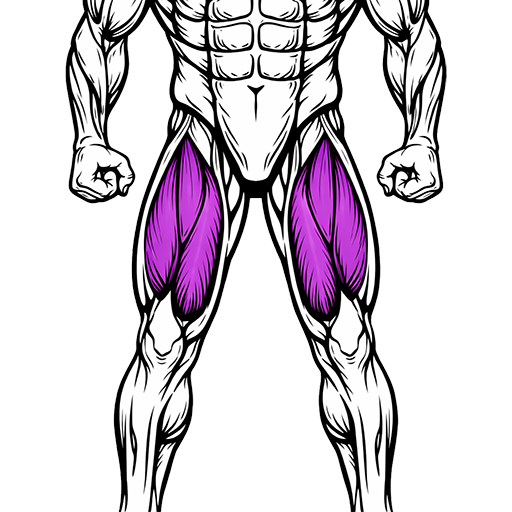
VILPA: Split-squat isometric
In Calicen, the split-squat hold is a high-value activity snack repeated every few hours to replace sitting with intense unilateral leg work. Its large-muscle isometric demand creates a meaningful local metabolic signal while training the strength, balance, and control needed for walking, stairs, and getting up from low positions.
Legs
Compound
At a glance
Difficulty
Intermediate
Exercise Type
Vilpa
Muscle Group
Quadriceps
Equipment
Bodyweight
Force Type
Push
Mechanics
Compound
Why this exercise matters
This is one of the most functionally valuable Calicen VILPAs because it joins metabolic interruption with single-leg capacity. It is especially relevant to maintaining lower-body reserve for later life.
- Metabolic reactivation — Hard unilateral leg tension sharply raises energy demand in the working muscles; AMPK signaling depends on the actual workload and is acute, not all-day continuous.
- Mobility independence — Quadriceps and glute strength support stairs, lunging, floor transfers, and recovering balance during a step.
- Single-leg control — The stance trains the foot, knee, hip, and pelvis to remain organized on one primary support leg.
- Isometric potential — Regular isometric exercise can reduce resting blood pressure, although direct evidence is stronger for standardized wall-squat protocols than split-squat holds.
How to perform
Treat the practice as a brief, deliberate movement break and keep the prescribed quality more important than the clock.
- Setup — Use Optional support and clear enough space to hold or repeat the position safely.
- Prescription — Complete 2–3 × 20–45 sec/side.
- Key cue — Keep front foot planted and knee tracking comfortably.
- Reset — Relax fully or return to an easy position between efforts rather than carrying unnecessary tension.
- Scale — Use support and a shallower position to scale.
What to avoid
Do not let the short format justify poor positioning or excessive effort. The activity should remain repeatable and symptom-free.
- Exercise-specific safety — Use support and a shallower position to scale.
- Breathing/tension — Keep front foot planted and knee tracking comfortably; avoid unnecessary breath-holding unless the technique explicitly requires a gentle respiratory phase.
- Stop criteria — Stop for sharp pain, numbness, dizziness, or loss of control.
- Terminology — This website category is broader than the scientific definition of VILPA.
- Escaping tension — Do not rise, twist, or push off the rear leg to extend time; shorten the hold while keeping the front foot, knee, and pelvis controlled.
Target Muscle