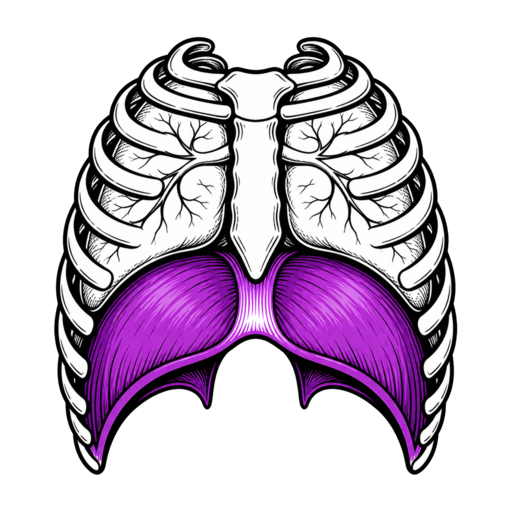
VILPA: Abdominal vacuum
In Calicen, the abdominal vacuum is a low-fatigue exercise snack placed every few hours to interrupt passive sitting with breath and deep-trunk control. Its main purpose is neuromuscular organization of the abdominal wall; it should not be marketed as vigorous AMPK activation, belly-fat loss, or a major muscle-building drill.
Cardio
Isolated
At a glance
Difficulty
Intermediate
Exercise Type
Vilpa
Muscle Group
Diaphragm
Equipment
Bodyweight
Force Type
Static
Mechanics
Isolation
Why this exercise matters
The vacuum earns its place as a frequent skill practice, not as a metabolic blockbuster. It is useful when the desired result is finer control with almost no recovery cost.
- Deep-core awareness — It makes gentle inward abdominal tension and transverse-abdominis control easier to identify and reproduce.
- Breath coordination — Practice distinguishes drawing in from breath-holding and from the stronger brace used for heavy lifting.
- Postural organization — Improved awareness can help organize ribs, abdomen, and pelvis during low-load positions and posing.
- High repeatability — Low soreness and minimal equipment make short practice easy to distribute through the day.
How to perform
Treat the practice as a brief, deliberate movement break and keep the prescribed quality more important than the clock.
- Setup — Use None and clear enough space to hold or repeat the position safely.
- Prescription — Complete 3–5 × 10–20 sec.
- Key cue — Exhale gently, draw abdomen inward, then resume normal breathing.
- Reset — Relax fully or return to an easy position between efforts rather than carrying unnecessary tension.
- Scale — Avoid prolonged breath holds; skip during pregnancy unless cleared.
What to avoid
Do not let the short format justify poor positioning or excessive effort. The activity should remain repeatable and symptom-free.
- Exercise-specific safety — Avoid prolonged breath holds; skip during pregnancy unless cleared.
- Breathing/tension — Exhale gently, draw abdomen inward, then resume normal breathing; avoid unnecessary breath-holding unless the technique explicitly requires a gentle respiratory phase.
- Stop criteria — Stop for sharp pain, numbness, dizziness, or loss of control.
- Terminology — This website category is broader than the scientific definition of VILPA.
- Wrong expectation — Vacuum practice does not selectively burn belly fat or replace progressive trunk training; use it for control, not as a waist-loss shortcut.
Target Muscle