VILPA: Front plank (planche-style hold)
In Calicen, the front plank is a brief activity snack used every few hours to break up sitting with isometric trunk and shoulder work. It is excellent for bracing endurance; because it uses less active muscle mass than a hard leg exercise, its whole-body metabolic and AMPK stimulus is likely smaller.
Compound
Strength
At a glance
Difficulty
Intermediate
Exercise Type
Vilpa
Muscle Group
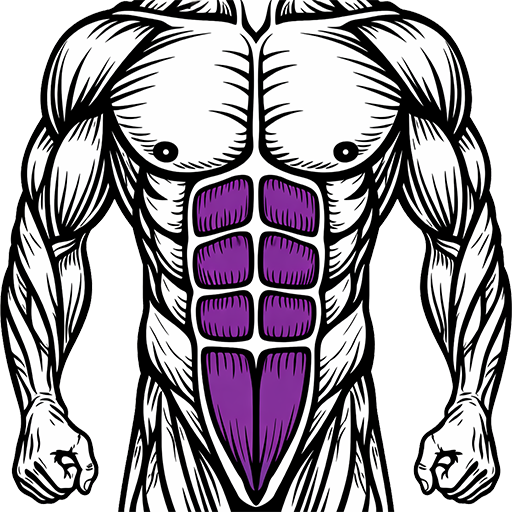
Abs
Equipment
Bodyweight
Force Type
Static
Mechanics
Compound
Why this exercise matters
The plank’s main payoff is reliable trunk endurance in a very short, accessible format. It contributes to an all-day active pattern without pretending to equal vigorous whole-body exercise.
- Activity interruption — A short rigid hold replaces another uninterrupted block of sitting with purposeful muscular work.
- Bracing endurance — The abdominal wall resists lumbar extension and helps the torso transmit force during lifting, carrying, gait, and transfers.
- Shoulder support — Controlled pressure through the forearms trains the shoulder blades and upper body to support load without collapse.
- Isometric context — Regular isometric training can improve resting blood pressure, but direct evidence is stronger for wall-squat and handgrip protocols than for planks.
How to perform
Treat the practice as a brief, deliberate movement break and keep the prescribed quality more important than the clock.
- Setup — Use Floor; mat and clear enough space to hold or repeat the position safely.
- Prescription — Complete 3 × 20–60 sec.
- Key cue — Squeeze glutes; keep ribs stacked over pelvis.
- Reset — Relax fully or return to an easy position between efforts rather than carrying unnecessary tension.
- Scale — Use knees-down or elevated plank; a true gymnastics planche is a different advanced skill.
What to avoid
Do not let the short format justify poor positioning or excessive effort. The activity should remain repeatable and symptom-free.
- Exercise-specific safety — Use knees-down or elevated plank; a true gymnastics planche is a different advanced skill.
- Breathing/tension — Squeeze glutes; keep ribs stacked over pelvis; avoid unnecessary breath-holding unless the technique explicitly requires a gentle respiratory phase.
- Stop criteria — Stop for sharp pain, numbness, dizziness, or loss of control.
- Terminology — This website category is broader than the scientific definition of VILPA.
- Long poor holds — A shorter rigid plank is more effective than a long sagging one; stop when ribs flare, the lower back arches, or shoulders collapse.
Target Muscle