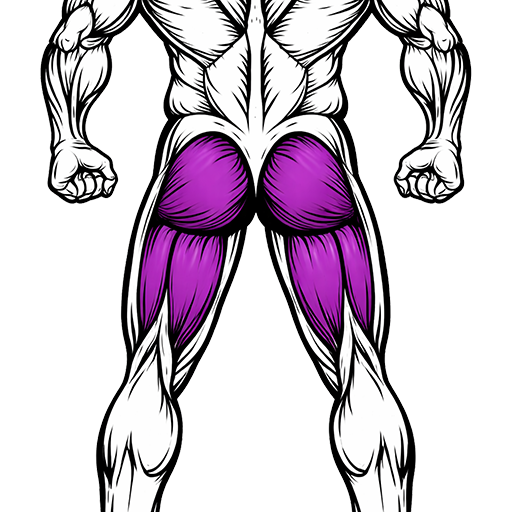
Nordic hamstring curl
The Nordic hamstring curl is a high-tension knee-flexor exercise performed from kneeling with the ankles anchored. The hamstrings resist the body falling forward, making the eccentric phase especially demanding even without external weight.
Legs
Isolated
Strength
Flexibility
At a glance
Difficulty
Advanced
Exercise Type
Hypertrophy
Muscle Group
Hamstrings
Equipment
Bodyweight
Force Type
Pull
Mechanics
Isolation
Why this exercise matters
The Nordic curl matters because it exposes the hamstrings to very high eccentric tension with little equipment. It is also well studied as part of hamstring-injury-prevention programs.
- Eccentric strength — The hamstrings control a long body lever.
- Knee-flexor focus — The movement directly challenges knee flexion capacity.
- Minimal loading — Body position creates substantial resistance.
- Scalable exposure — Bands, hand support, and range make gradual entry possible.
How to perform
Begin with 2–4 sets of 4–8 repetitions and rest 2–3 minutes. Most people should start with band or hand assistance and a short range.
- Anchor — Kneel on padding and secure the ankles under a stable anchor or trained partner.
- Align — Form a straight line from knees through hips to head and lightly brace the trunk.
- Lower — Lean forward from the knees while resisting the descent as long as possible.
- Assist — Catch with the hands or use a band, then use enough help to return without losing alignment.
- Progress — Increase range before reducing assistance or adding repetitions.
What to avoid
Nordic curls can create substantial soreness and should be introduced with low volume and gradual progression.
- Sudden volume — Do not begin with maximal range and many repetitions.
- Hip break — Avoid folding at the hips to shorten the lever unintentionally.
- Weak anchor — Do not use furniture or a partner who cannot secure the ankles.
- Acute pain — Stop for sharp knee, hamstring, or calf pain rather than pushing through it.
Target Muscle