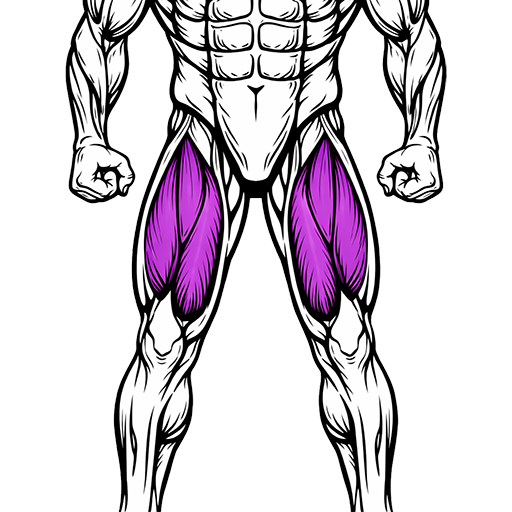
Heel-elevated split squat
The central task in Heel-elevated split squat is split squat led by Quadriceps and supported by Glutes; adductors. Programming role — Unilateral quad bias with large knee travel. Defining feature — Trains each leg and exposes asymmetry.
Legs
Compound
At a glance
Difficulty
Intermediate
Exercise Type
Hypertrophy
Muscle Group
Quadriceps
Equipment
Dumbbell
Force Type
Push
Mechanics
Compound
Why this exercise matters
Heel-elevated split squat matters because it has a clearly defined training role: Unilateral quad bias with large knee travel. Its structure keeps the exercise choice specific to the intended adaptation.
- Primary stimulus — Quadriceps leads the movement; Glutes; adductors contributes.
- Programming role — Unilateral quad bias with large knee travel.
- Why this version — Trains each leg and exposes asymmetry.
How to perform
Use 2–4 × 8–15/side as a working template and allow about 90–150 sec between sets. The aim is repeatable tension, not simply moving the heaviest load.
- Equipment setup — Prepare Dumbbells; wedge/plates and choose a load that preserves the intended split squat.
- Starting position — Establish a stable split stance and load the full front foot before descending.
- Repetition path — Lower vertically between both legs, then press through the front foot to rise.
- Exercise-specific cue — Use support if balance limits the target muscle.
- Set endpoint — End the set when the target muscles can no longer control the same path and tempo.
What to avoid
The main safeguard is exercise-specific: Use support if balance limits the target muscle. Load and range should preserve the defining split squat pattern.
- Setup risk — Confirm that Dumbbells; wedge/plates is stable and correctly adjusted before loading.
- Technique limit — Do not chase repetitions once the intended path changes or another body segment takes over.
- Joint response — Reduce load or range for sharp, increasing, or joint-specific pain.
- Progression — Add resistance only after the listed cue can be maintained across the whole set.
Target Muscle